Smart Revise: The Complete Guide to Smart Revision for Computer Science and Business Studies
How Smart Revise Uses Cognitive Science and Structured Learning to Help Students Achieve Higher Grades in School Exams

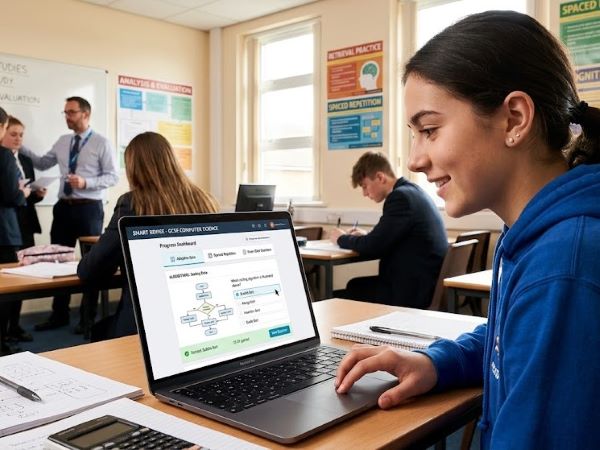
Smart Revise is an online revision platform designed mainly for Computer Science and Business Studies students that uses cognitive science techniques such as spaced repetition, retrieval practice, and exam-style questions to improve long-term memory, understanding, and academic performance. It provides structured learning pathways, examiner-written content, and adaptive quizzes that help students focus on weak areas while allowing teachers to track progress and assign targeted revision tasks for better exam preparation results.
Table of Contents
ToggleIntroduction to Smart Revise and Its Purpose
Smart Revise is designed to address one of the biggest challenges students face during exam preparation, which is not just learning content but remembering and applying it effectively under exam conditions. Many students study by rereading notes or highlighting textbooks, but these methods often lead to short-term familiarity rather than long-term retention. Smart Revise changes this approach by using evidence-based learning strategies that actively engage the brain in recalling and applying knowledge repeatedly over time.
The platform is widely used in Computer Science and Business Studies education because these subjects require both conceptual understanding and the ability to answer structured exam questions. Smart Revise bridges the gap between learning and exam performance by offering targeted practice that reflects real exam formats and expectations.
Understanding How Smart Revise Works
The foundation of Smart Revise lies in cognitive science, which studies how the brain learns and remembers information. Instead of passive reading, the platform focuses on active learning techniques that strengthen memory pathways.
One of the core methods used is retrieval practice, which encourages students to recall information from memory rather than simply reviewing it. This strengthens long-term retention and improves recall during exams. Another key method is spaced repetition, where topics are revisited at increasing intervals to reinforce memory before forgetting occurs. This structured repetition ensures that knowledge is not only learned but retained for longer periods.
The platform also incorporates interleaving, where different topics are mixed during revision sessions. This improves problem-solving skills by training the brain to switch between concepts, similar to what happens in real exams.
Key Features of Smart Revise
Smart Revise offers a variety of tools that support both students and teachers in the revision process. One of its most important features is its question bank, which includes exam-style questions created by experienced educators. These questions are designed to match the difficulty level and structure of actual exam papers.
Another major feature is adaptive learning, where the system tracks student performance and identifies weak areas. Based on this data, it provides targeted questions to help students improve specific topics rather than repeating what they already know.
The platform also includes quizzes, flashcards, and topic-based tests. These tools allow students to revise in short, focused sessions, which is proven to be more effective than long study periods without structure.
For teachers, Smart Revise provides dashboards that show student progress in real time. This helps educators identify struggling students early and adjust teaching strategies accordingly. Teachers can also assign homework and revision tasks directly through the platform, ensuring consistent learning outside the classroom.
Why Smart Revise Is Effective for Exam Preparation
One of the main reasons Smart Revise is effective is because it focuses on active recall rather than passive learning. Active recall forces the brain to retrieve information, which strengthens memory connections and improves exam performance.
Another reason is its alignment with exam board specifications. The content is structured to match what students will actually see in their exams, making revision more targeted and relevant. This reduces wasted time on unnecessary topics and allows students to focus on high-priority areas.
The platform also reduces exam anxiety by providing continuous practice under exam-like conditions. When students repeatedly practice structured questions, they become more confident and familiar with exam formats, which improves performance under pressure.
Smart Revise in Computer Science Education
Computer Science is a subject that requires both theoretical understanding and practical application. Students must learn concepts such as algorithms, programming logic, data representation, and system architecture. Smart Revise supports this by breaking down complex topics into manageable sections and reinforcing them through repeated practice.
The platform includes coding-related questions, theory explanations, and structured problem-solving tasks. This combination ensures that students not only understand concepts but can also apply them in exam scenarios. By regularly practicing these skills, students become more confident in answering both short-answer and long-answer questions.
Smart Revise in Business Studies Education
Business Studies requires students to understand real-world scenarios, apply theories, and evaluate business decisions. Smart Revise supports this by providing case-study based questions and structured evaluation tasks.
Students are encouraged to practice analysis and evaluation skills, which are essential for higher-grade answers. The platform helps them learn how to structure responses, use business terminology correctly, and develop logical arguments based on given scenarios.
This structured approach ensures that students are not just memorizing definitions but are also learning how to apply knowledge in realistic business contexts.
Benefits for Students Using Smart Revise
Students benefit from Smart Revise in several ways. One of the most important benefits is improved retention of information. Because the platform uses repetition and active recall, students are more likely to remember what they learn over long periods.
Another benefit is better time management. Instead of revising everything at once before exams, students can follow structured revision plans that break learning into smaller, manageable sessions. This reduces stress and improves efficiency.
Students also gain immediate feedback on their performance. This helps them understand mistakes and learn from them quickly, which is essential for improvement.
Benefits for Teachers Using Smart Revise
Teachers benefit from Smart Revise because it reduces the workload of creating and marking assessments. The platform automatically grades many types of questions and provides detailed analytics on student performance.
This allows teachers to focus more on teaching and less on administrative tasks. They can also identify which students need extra support and which topics need more classroom attention.
The ability to assign targeted revision tasks also ensures that students receive personalized learning experiences, even in large classrooms.
The Role of Cognitive Science in Smart Revise
Cognitive science plays a central role in how Smart Revise is designed. The platform is built on the understanding that memory improves when learning is active, repeated, and spaced over time.
Retrieval practice strengthens neural pathways by forcing the brain to recall information without prompts. Spaced repetition prevents forgetting by reviewing material just before it is likely to be forgotten. Interleaving improves adaptability by mixing different topics during practice sessions.
These techniques are widely supported by educational research and are proven to improve long-term academic performance when used consistently.
How Smart Revise Improves Exam Performance
Exam performance depends not only on knowledge but also on the ability to apply that knowledge under timed conditions. Smart Revise prepares students for this by simulating exam environments through timed quizzes and structured questions.
Students learn how to manage time effectively, structure answers properly, and avoid common mistakes. Over time, this leads to improved confidence and higher scores in actual exams.
The consistent feedback loop also ensures continuous improvement, as students can track their progress and focus on weak areas before exams.
Limitations of Smart Revise
While Smart Revise is highly effective, it is not a complete replacement for traditional learning methods. Students still need to attend classes, read textbooks, and understand foundational concepts before using revision tools effectively.
Another limitation is that it works best when used consistently. Students who use it occasionally may not experience the full benefits of spaced repetition and retrieval practice.
It also depends on student motivation, as the platform requires active participation rather than passive learning.
Future of Smart Revise in Education
The future of Smart Revise and similar platforms is likely to involve more artificial intelligence and personalization. As educational technology continues to develop, revision platforms may become even more adaptive, predicting student weaknesses more accurately and offering personalized learning paths.
There is also potential for expansion into more subjects and exam boards, making structured revision accessible to a wider range of students.
Conclusion
Smart Revise represents a modern approach to exam preparation that combines cognitive science with structured digital learning. By focusing on active recall, spaced repetition, and exam-style practice, it helps students improve memory retention and exam performance in a meaningful way. Its benefits for both students and teachers make it a valuable tool in today’s education system, especially for subjects like Computer Science and Business Studies where structured understanding and application are essential.