How Internal Podcasting Has Quietly Become a Real Channel for Modern Enterprises

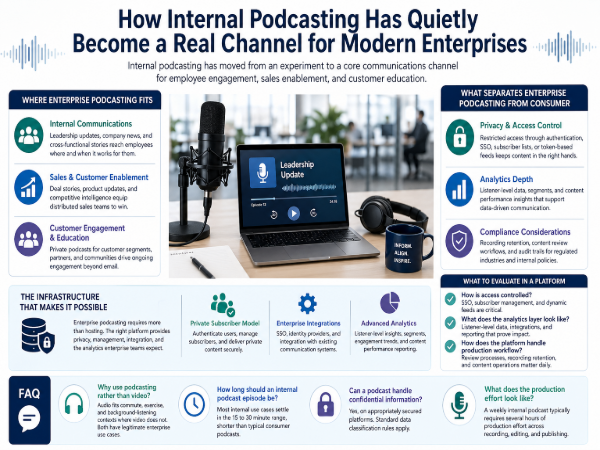
For most of podcasting’s first decade, the medium was a consumer phenomenon. Independent creators, eventually large networks, and increasingly professional production studios produced shows for general audiences. Inside the corporate world, podcasting was either ignored or treated as an external marketing channel for thought leadership.
That picture has shifted in interesting ways since 2022. A growing number of large enterprises have moved internal podcasting from an experimental side-project into a structured communications channel that sits alongside email, video, and Slack as part of the formal employee-engagement and customer-engagement infrastructure.
Where enterprise podcasting actually fits
Three specific use cases have driven the adoption.
Internal communications
Distributed and hybrid workforces have made one-way written communication insufficient on its own. Podcast-format content from leadership, organisational updates, and cross-functional storytelling reach employees during commutes, exercise, and other contexts where written content does not.
Sales and customer enablement
Customer-facing teams in technology, financial services, healthcare, and complex B2B sectors use private podcasts to distribute deal stories, product updates, and competitive intelligence to dispersed sales teams.
Customer engagement and education
Private subscriber-only podcasts for specific customer segments, partner programmes, and exclusive communities have become a recognisable channel for ongoing engagement beyond the email newsletter.
The infrastructure that supports this is not the same as the infrastructure that supports public podcasting. Privacy controls, subscriber management, integration with identity providers, and the analytics that enterprise communications teams expect all need different platform capability than consumer podcasting platforms provide.
Specialist platforms positioned as an enterprise podcast solution handle the private-subscriber model, integration with corporate identity, listener analytics, and the operational layer that enterprises need to run podcasting at scale rather than as a side project.
What separates enterprise podcasting from consumer podcasting
Three structural differences distinguish the two.
Privacy and access control. Enterprise podcasts typically restrict access to authenticated audiences through subscriber lists, identity provider integration, or token-based access.
Analytics depth. Enterprise communications teams need listener-level data, segment analysis, and the operational metrics that consumer podcasting platforms either do not provide or provide only in aggregate.
Compliance considerations. Many regulated industries (financial services, healthcare, legal) require recording retention, content review workflows, and audit trails that consumer platforms do not support.
What to evaluate in a platform
Three questions cover most of the decision.
How is access controlled? Authentication options including SSO, subscriber list management, and dynamic feed generation matter for enterprise use.
What does the analytics layer look like? Listener-level data, integration with existing communications analytics, and content performance reporting are all relevant.
How does the platform handle production workflow? Internal review processes, recording retention, and the broader content-operations layer affect day-to-day usability.
FAQ
Why use podcasting rather than video?
Audio fits commute, exercise, and background-listening contexts where video does not. Both have legitimate enterprise use cases.
How long should an internal podcast episode be?
Most internal use cases settle in the 15 to 30 minute range, shorter than typical consumer podcasts.
Can a podcast handle confidential information?
Yes, on appropriately secured platforms. Standard data classification rules apply.
What does the production effort look like?
A weekly internal podcast typically requires several hours of production effort across recording, editing, and publishing.