How Online Pharmacies Are Quietly Reshaping the Way Britain Picks Up Its Prescriptions

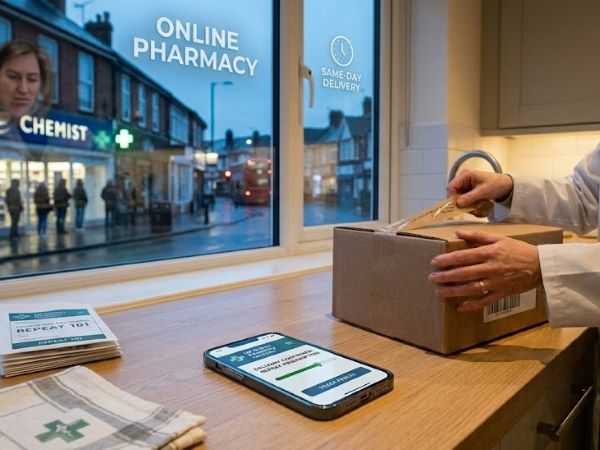
The high-street pharmacies has been one of the most familiar fixtures of British life for a century. The bell over the door, the tiled counter, the prescription handed over a glass partition while a queue of people pretend not to listen. For most of the last hundred years, that is how the country has collected its medicines.
That picture has been changing faster than most of us have noticed. The shift is not dramatic enough to make headlines. It is a quieter sort of change, the kind that happens through the cumulative weight of small decisions, made by tens of thousands of people each month, until one day the landscape looks different.
A Habit That Reformed Itself
The pandemic accelerated something that was already beginning to move. Repeat prescriptions had been migrating online in modest numbers for several years before 2020, mostly among younger patients and those on long-term medication. By the end of that period, the migration had quietly become a mainstream behaviour.
The reasons are unromantic but practical. The pharmacies queue at a Wednesday lunchtime in a market town is no shorter than it used to be, and the pharmacies behind the counter is often the only one in the building. For working parents, for shift workers, for anyone trying to coordinate a hospital appointment with a medication change, the ability to handle the whole process through a phone has been a meaningful change in convenience.
A registered UK online pharmacy sits within the same regulatory framework as the shop on the high street. The same training, the same controls, the same accountability to the General Pharmaceutical Council. What differs is the delivery. The medication arrives at the door in unbranded packaging, often the next day, without anyone in the queue noticing what was collected.
The Privacy Shift
That privacy point matters more than it sounds. There has always been a quiet awkwardness around certain medications. Conditions that people would rather not advertise to a neighbour standing behind them at the till. Treatments that, although entirely routine, carry a residue of social embarrassment that most patients would prefer not to navigate at four o’clock on a Friday.
Online dispensing has stripped that awkwardness out of the experience. A pharmacies still reviews each order. A registered professional still cross-checks for interactions. But the moment of collection happens through a parcel delivery, with no audience and no small talk.
For sensitive conditions in particular, the change has been substantial. pharmacies themselves have commented in industry surveys that patients are presenting with concerns earlier, often because the act of seeking help no longer requires a public visit.
What Still Happens Face to Face
It is worth being clear about what the change has not done. The high-street pharmacies is not disappearing. Vaccinations, blood pressure checks, contraceptive consultations, the new range of NHS-funded clinical services rolled out across pharmacies over the past two years, all of these depend on a physical premises and a trained pharmacies on site. For walk-in advice and minor ailments, the local pharmacies remains the first port of call for a substantial part of the country.
What has happened is a sorting. The acute, the urgent, the in-person interactions stay where they have always been. The repeat prescriptions, the predictable orders, the over-the-counter routine purchases have moved to the post. The pharmacies role at each end of that pipeline is the same; only the patient’s experience of it has changed.
The Numbers Behind the Shift
Industry estimates suggest that the proportion of UK prescription items dispensed online has more than tripled since the start of the decade. The growth is steady rather than spectacular, but compound steadiness over five years adds up. By the latter half of this decade, it is reasonable to expect that the average British household will be receiving at least some of its medicines through the door rather than collecting them in person.
That is not a small change, even if it has happened without much fanfare. It is one of those shifts that will be hard to imagine once it is complete, and difficult to remember once it has been normal for a generation.
The bell over the door is not going anywhere. It just rings a little less often than it used to.