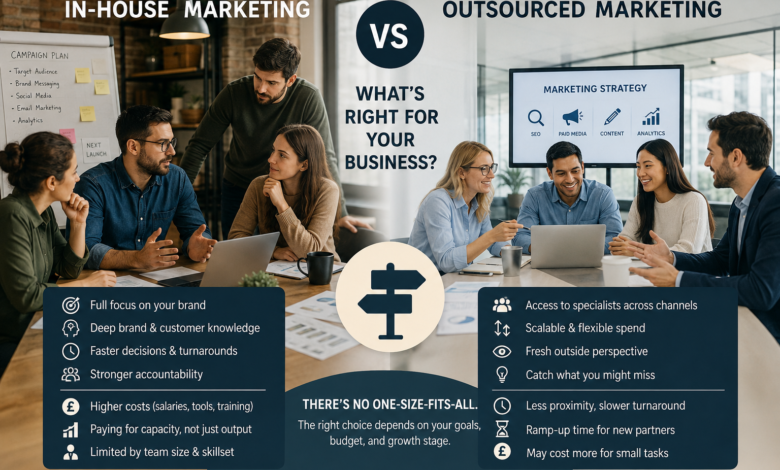
There’s no right or wrong answer here. Every business is different, and the only thing that matters is what’s right for you.
In-house and outsourcing can both work. They can also both be disasters. Making the right decision for your business means establishing what you need from marketing, and what you’re prepared to put into it. What’s your budget? What’s your growth stage? These, plus a thousand more questions, are what it takes to make the right choice.
What in-house marketing gives you
The biggest advantage is full, undivided attention. In-house, your team works on your brand and your brand only. There’s no other difficult client muscling in and stealing focus; in fact, when you hire in-house, the most difficult client is you.
In-house marketing gives you focus. You’ll feel that focus in faster turnarounds, quicker decisions, shorter sign-off loops and more accountability. Your team also builds knowledge that’s hard to replicate from outside. They know your product, your customers, and the reasons past campaigns worked (or didn’t), giving them valuable context that’s difficult to replicate externally. Ask them why a launch underperformed last spring, and they’ll know.
So far, so good, right? Well, this level of focus and individual attention doesn’t come for free. Salaries, benefits, software, training, and costs add up. For every positive, like the compounded, ever-growing knowledge of a team member, there’s a negative, said team member’s compounded, ever-growing salary, and irreplaceability.
Also, you’re paying for capacity, not just output. That means you’re paying even when campaigns aren’t running. Plus, with a small team, there’s a skill ceiling. Individuals are rarely excellent at SEO, paid media, email, and content all at once.
Even strong in-house teams hit that ceiling eventually. A new channel needs testing, or a specific skill nobody on the team has yet. That’s usually where digital marketing agencies london can help.
What outsourced marketing gives you
Breadth. An agency brings specialists across channels under one roof, something that’s difficult to match with one hire or a small internal team. You get access to skills you’d otherwise have to hire five different people for, without carrying five different salaries.
You also get flexibility. Scale spend up during a busy quarter, dial it back when things are quieter. No redundancies or HR headaches. Outsourced marketing can adapt to the different growth cycles your business goes through.
With an external team, you also get an outside perspective. An external team isn’t shaped by the same internal habits or assumptions, so they tend to catch things an internal team is too close to see. A marketing partner sees things from a step back. You lose a little of that brand focus, but maybe you see a bit of the bigger picture, too.
The trade-off to all of this is proximity and speed. You’re not in the same office, smaller tasks can’t be done as quickly or as easily, and you’ll probably get billed for it as well. Also, when you start out working together, you have to consider ramp-up time. A good agency gets to grips with a new client quickly, but not immediately.
When do I pick one over the other?
In-house tends to suit businesses with the budget to build a proper team, around work that needs constant close attention. Outsourcing tends to suit smaller businesses that need several specialisms running at once, without the salaries that come with them. It also suits teams that want to test or scale marketing spend without committing to long-term hires.
Plenty of businesses land somewhere in between. Strategy and brand stay in-house, where the context lives. Execution and specialist skills get outsourced, where breadth matters more than proximity. It’s about matching jobs to resources and marketing efficiently.
Making the call
If you have a preference for one model over the other, try to forget about it. Both approaches have their strengths; there really isn’t a one-size-fits-all solution. If what you need is speed and proximity, in-house probably wins. If what matters to your business is deep skills and flexibility, then an agency is probably the way to go.
Budget and growth stage matter as much as the actual work. A business scaling fast might need outsourced flexibility today and an in-house team in two years’ time. The right structure now won’t be the right structure forever.