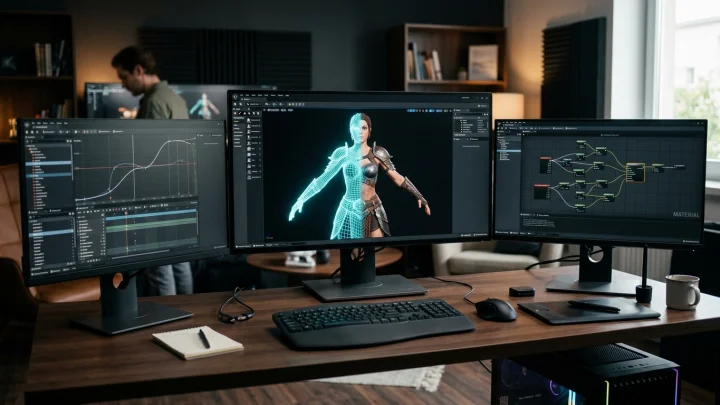
Real-time entertainment engines demand rigorous spatial geometry, clean edge loops, and disciplined material parameters. For decades, building interactive character meshes, hard-surface props, and interactive environment pieces has required multi-week production sprints across digital sculpting, manual retopology, UV unwrapping, and texture baking. While early generative utilities produced irregular polygonal clouds that choked game engines, modern spatial reconstruction networks can now deliver structured meshes directly from two-dimensional concept sheets. As independent studios and AAA art outsourcers integrate algorithmic image to 3D model generation into their pre-production and staging workflows, interactive 3D asset authoring is shifting from manual labor toward programmatic asset synthesis.
Addressing these technical challenges, N4D introduces an algorithmic pipeline built specifically for production-focused spatial modeling. Developed from spatial deep learning architectures, the system couples dense volumetric boundary synthesis with deterministic mesh extraction and decoupled physically based rendering (PBR) materials. Rather than generating chaotic polygonal surfaces that require complete manual rebuilds, the engine provides structured quad-dominant and triangle geometry calibrated for real-time viewports. In this technical breakdown, we examine the mechanics of modern generative spatial pipelines, reviewing Direct3D-S2 spatial attention, A-pose rigging preparation, edge flow continuity, draw call mitigation, and real-time engine staging.
Production Bottlenecks in Modern Game Asset Creation
Game art production operates under strict hardware performance budgets. Unlike offline visual effects, where individual film assets can feature millions of subdivision surfaces and dozens of 8K UDIM texture tiles, real-time engines such as Unreal Engine 5 and Unity must sustain 60 to 120 frames per second on consumer desktop and console hardware.
When art directors attempt to incorporate legacy generative 3D tools into game pipelines, technical artists encounter several structural bottlenecks:
- Unstructured Triangle Soup: Early neural reconstruction systems generate surfaces as chaotic, unorganized triangle meshes. These meshes feature self-intersecting faces, non-manifold edges, and internal floating vertices that trigger computational errors inside game engine physics solvers and occlusion culling routines.
- Prohibitive Manual Retopology Cycles: Converting a raw high-poly concept sculpt into an engine-compliant low-poly mesh demands extensive manual surface tracing in DCC suites. Technical artists spend between 12 and 30 hours per character asset placing edge loops around deforming articulation points like shoulders, elbows, and knees.
- Burnt-In Lighting Contamination: Standard photogrammetry tools and primitive generative algorithms frequently bake directional highlights, hard cast shadows, and ambient occlusion into base surface textures. When imported into dynamic real-time scenes with moving light sources, these baked shadows conflict with dynamic engine lighting, destroying scene immersion.
- Unpredictable Articulation Poses: Generating character meshes from arbitrary concept art often yields asymmetrical, dynamic fighting stances. Because the limbs cross and clothes fold unpredictably, rigging artists cannot insert standard skeletal armatures without tearing the underlying geometry.
To overcome these barriers, game development teams require spatial generation systems that generate predictable rest poses, output disciplined edge flows, and separate ambient scene lighting from base material pigments.
Algorithmic Foundation: Direct3D-S2 and Spatial Sparse Attention
Reconstructing clean three-dimensional game assets from single 2D concept images requires high geometric precision without overloading GPU hardware memory. Traditional generative models calculate coordinates across uniform 3D voxel grids. Because voxel memory allocation scales cubically (O(N3)), uniform volumetric representations encounter strict memory walls around 512³ resolution, rounding off sharp armor edges, facial features, and weapon silhouettes.
N4D addresses this limitation through its Direct3D-S2 algorithm, an architecture validated in NeurIPS 2025 research. The core system relies on Spatial Sparse Attention (SSA). Instead of assigning computational threads uniformly across vacant coordinate space surrounding an object, SSA concentrates tensor operations strictly on active voxels containing the surface boundary shell. This targeted numerical focus enables native volumetric reconstruction up to 2048³ resolution, capturing intricate mechanical seams, organic contours, and anatomical landmarks directly from single concept orthographics.
The generation timeline within this framework operates across two distinct, measurable computational stages:
- Untextured Base Mesh Extraction: Generating an untextured white boundary mesh requires approximately 90 seconds. During this initial calculation, the neural network resolves spatial depth, surface normals, and silhouette continuity across all occluded angles.
- PBR Material and Texture Synthesis: Generating multi-channel physically based rendering maps is a separate, computationally intensive pipeline step. Computing diffuse albedo, roughness, metallic, and normal maps requires dedicated tensor processing passes. Consequently, compiling a complete, production-grade textured GLB asset requires over two minutes in total elapsed time.
This staged timeline provides game art directors with a rapid prototyping loop. Evaluating an untextured white model within 90 seconds allows character leads to inspect silhouette balance, limb proportions, and anatomical mass before committing GPU cycles to material baking.
Rigging-Ready Generation: A-Pose Guidance and Quad-Dominant Topology
For character artists and technical animators, mesh topology determines whether an asset can deform naturally during skeletal movement. A mesh with irregular edge directions wrinkles, pinches, or collapses whenever an underlying bone rotates.
To streamline character preparation, N4D introduces specialized Pose guidance parameters alongside flexible geometric topology selection:
1. Standardized A-Pose and T-Pose Generation
Rather than forcing artists to accept arbitrary dynamic poses from concept art, users can toggle A-Pose or T-Pose controls during the generation setup. The neural network algorithmically straightens the limbs, establishes symmetrical shoulder angles, and separates the arms from the torso. This standardized rest pose allows technical animators to map standard humanoid skeletons directly to the generated mesh without manual limb straightening.
2. Quad-Dominant Edge Flow Alignment
Game production relies heavily on quad geometry for skeletal deformation. The platform provides pre-generation topology selection, allowing developers to choose between quad-dominant meshes and standard triangle meshes:
- Triangle Topology: Default configuration with polycount budgets from 100,000 to 500,000 polygons, optimal for hard-surface environment props and high-frequency geometric detailing.
- Quad-Dominant Topology: Tailored for animated characters and deformable creatures, supporting configurable polycount targets from 1,000 to 100,000 polygons. Choosing quad topology aligns continuous edge loops along primary deformation axes, preventing texture stretching across joints.
- Targeted Export Standards: While triangle meshes export as standard GLB assets, quad-dominant character assets download as clean .OBJ files, preserving quadrilateral polygon assignments for immediate refinement in Blender, Maya, or ZBrush. Generating a complete asset with quad topology, texture mapping, and PBR materials consumes 35 Credits.
Engine-Ready Topology Benchmark Matrix
To assist technical directors and lead modelers in evaluating geometry standards, the following comparison matrix contrasts traditional manual retopology, legacy generative cloud tools, and the algorithmic pipeline implemented in N4D:
| Technical Dimension | Manual DCC Retopology | Legacy Generative Cloud Tools | N4D Direct3D-S2 Pipeline | Game Studio Impact |
| Skeletal Articulation | Manually aligned to joints | Asymmetrical with fused limbs | Standardized A-Pose / T-Pose guidance | Eliminates manual limb straightening before rigging |
| Edge Loop Flow | Hand-drawn continuous loops | Disorganized triangle soup | Quad-dominant edge flow (1K-100K poly) | Prevents mesh pinching and volume collapse in animation |
| Turnaround Time | 12 to 30 hours per character | 60 seconds (unusable geometry) | 90s base mesh, 2+ min textured GLB | Accelerates character prototyping cycles by 10x |
| Deformation Stability | High deformation predictability | Unusable due to self-intersections | Clean manifold surface shells | Reliable skinning weight transfer in engine DCC tools |
| Material Decoupling | Hand-painted diffuse albedo | Burnt-in key light and shadows | Decoupled albedo, roughness, normal | Reacts accurately to real-time dynamic engine lighting |
| Polycount Control | Manually budgeted | Fixed or uncontrolled polycount | Dual slider control (1K to 500K faces) | Matches specific LOD tiers and target platform limits |
Real-Time Performance Ladder: LOD Hierarchy and Draw Call Reduction
Integrating generative assets into runtime game builds requires disciplined optimization to control draw calls and vertex shader overhead. Game engines submit draw calls to the GPU for each unique material pass and mesh section. If background props contain excessive polycounts or uncompressed textures, frame rendering times quickly exceed frame budgets.
To manage real-time overhead, game production studios employ a four-step optimization ladder:
Level 1: Volumetric Mesh Synthesis and Silhouette Verification
Concept art is ingested through the Direct3D-S2 pipeline. Within 90 seconds, the base geometric envelope is resolved. Lead artists verify silhouette readability at long camera distances, confirming that character proportions match art direction before allocating further resources.
Level 2: Illumination Decoupling and PBR Surface Baking
Surface textures are processed through deep illumination separation algorithms. The engine extracts pure diffuse albedo maps, purging directional highlights and ambient occlusion shadows. Roughness, metallic, and normal maps are generated as separate channels, ensuring the asset interacts accurately with dynamic engine lights and deferred screen-space reflections.
Level 3: Level of Detail (LOD) Generation and Polygon Decimation
Using the target polygon slider, technical artists generate discrete LOD tiers:
- LOD 0 (Hero Distance, 0 to 5 meters): 35,000 to 50,000 quad polygons for close-up dialogue viewports.
- LOD 1 (Medium Distance, 5 to 15 meters): 12,000 to 18,000 polygons, preserving silhouette contours while removing micro-bevels.
- LOD 2 (Background Distance, 15 to 40 meters): 3,000 to 6,000 polygons, merging sub-mesh details into normal map projections.
- LOD 3 (Far Distance, 40+ meters): Under 1,000 polygons, functioning as lightweight silhouette proxies.
Level 4: Texture Compression and Real-Time Engine Staging
The resulting assets are packaged for real-time engine staging. Texture channels are packed into standardized utility maps (such as ORM textures combining Ambient Occlusion, Roughness, and Metallic), reducing memory bandwidth and GPU texture sampler calls during live scene rendering.
Cross-Platform Asset Distribution and Production Verification
While digital entertainment relies primarily on real-time rendering, production franchises increasingly bridge digital game models with physical promotional merchandise, collectible figurines, and tangible design prototypes.
When studios prepare digital assets for physical manufacturing or collector distributions, watertight mesh integrity becomes mandatory. A 3D model designed exclusively for rendering often features non-manifold geometry, paper-thin planes, and open surface holes that cause slicing software to fail. Generative geometry must maintain watertight boundary closures to pass verification tests across both rendering viewports and additive manufacturing toolpaths.
In community ecosystems and maker repositories such as DIY3D verified print profiles, digital creators upload, validate, and catalog printable model files. Accessing platforms with verified structural configurations helps artists and production teams benchmark wall thicknesses, geometric overhangs, and slicing settings, ensuring that spatial assets function reliably across both interactive gaming environments and real-world physical fabrication.
Conversational Geometric Iteration with N4D-2o
Game asset production rarely concludes with the first generative iteration. Art directors frequently request specific adjustments, such as modifying helmet proportions, sharpening shoulder plates, or thinning a weapon grip.
In traditional workflows, altering an existing model requires opening digital sculpting software, manually pushing vertices, and re-baking texture maps. N4D resolves this production friction through N4D-2o, a conversational multimodal assistant integrated into the 3D generation workspace:
- In-Session Natural Language Refinement: Artists issue natural language directives to adjust models generated within the active session. Prompts such as “broaden the chest armor by ten percent” or “sharpen the edge bevels on the pauldrons” adjust the geometry without requiring a complete generation restart.
- Surgical Geometric Control: Unlike blind regeneration, N4D-2o preserves established anatomical landmarks and global proportions while modifying target areas, maintaining production continuity.
- Economical Iteration Cost: Each conversational adjustment cycle consumes 30 Credits, providing a cost-effective alternative to multi-hour manual sculpting revisions.
Strategic Outlook for Real-Time Production
Game development pipelines are under relentless economic pressure to deliver richer worlds within shorter release windows. Traditional asset creation workflows, burdened by repetitive manual retopology and tedious UV unwrapping, struggle to keep pace with modern scale demands.
By combining Direct3D-S2 spatial attention, standardized A-pose generation, quad-dominant edge alignment, and decoupled PBR material synthesis, N4D establishes an enterprise-grade framework for real-time asset production. Studios can rapidly convert 2D visual development art into engine-ready meshes, reserving technical artist expertise for high-level world design, expressive animation, and runtime optimization.