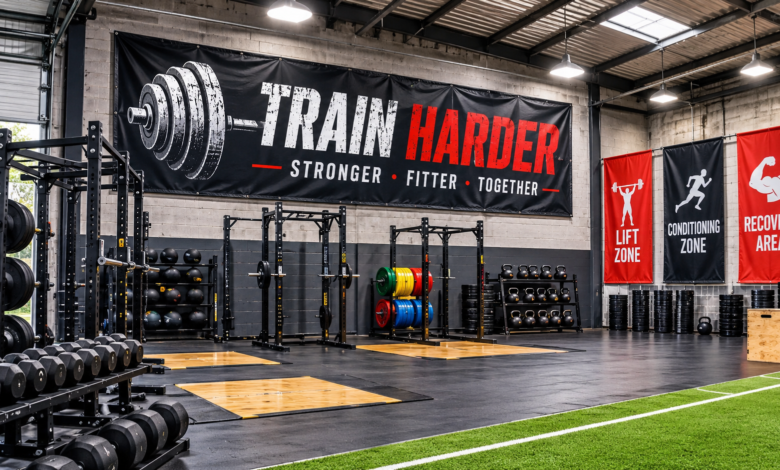
A warehouse gym starts with practical advantages: open floor space, high ceilings, durable surfaces, and room for heavy equipment. Bare walls, however, can make the facility feel unfinished and difficult to navigate.
A well-placed banner adds visual structure without taking up floor space. It gives training zones a clear identity, helping athletes understand where to focus before the first set. Thoughtful placement turns empty wall space into part of the gym’s daily function.
Why Visual Structure Matters
A large training room needs visual anchors. Without them, racks, platforms, storage areas, and walkways can blend together, especially under industrial lighting. A carefully positioned banner breaks up blank wall space and gives the eye a fixed point near the areas that matter most.
For facility owners, gym banners provide a practical way to add character without installing permanent wall treatments. They use vertical space, keep the floor clear, and give athletes a visual cue throughout each session. Placement, scale, and contrast determine whether that cue supports the room or distracts from it.
The best result comes from treating the banner as part of the layout. A banner above a lifting platform, beside a rack line, or behind a reception point can shape how people read the space.
Choose the Right Wall
The best wall has clear visibility, enough height, and little competition from equipment. A banner hidden behind plates, storage shelves, or cable attachments loses much of its impact. Before mounting anything, stand at several points in the room and note which surfaces remain visible during normal movement.
A wall near the main entrance creates an immediate visual identity. A wall behind a platform gives the lifting area a defined backdrop. A side wall near conditioning equipment can separate that zone from barbell work without adding partitions.
Ceiling height also affects proportion. A narrow banner can disappear on a tall warehouse wall, while an oversized design can dominate a compact room. The chosen size should match the viewing distance, not simply the available wall area.
Match Placement to Movement
Each training zone has its own rhythm, and the banner should support it. A powerlifting area benefits from a clean, fixed backdrop that remains visible between attempts. A strongman area needs open sightlines because implements, loads, and athletes move across a wider footprint.
Avoid placing banners where they create confusion around mirrors, timing displays, emergency equipment, or instructional signage. Those items already provide practical information, so the banner should occupy a nearby surface without competing for attention.
Lighting requires a close check. Direct glare can wash out printed colors, while a dim corner reduces readability. If the facility uses bright overhead fixtures, a perpendicular wall often provides a clearer view than a surface facing the lights.
Use the Banner to Define Zones
A plain warehouse becomes easier to use when each area has a recognizable visual marker. One banner can identify the main lifting wall, while another can establish a separate warm-up or recovery area. This approach gives the room order without requiring additional construction.
The method works well in shared facilities. New members can locate equipment faster when visual markers reinforce the physical layout. Coaches can also reference a banner’s position while directing groups, which reduces repeated explanations during busy sessions.
Install for Daily Use
Mounting should account for cleaning, airflow, and regular contact with equipment. A banner placed too close to a bar path, storage rack, or moving implement can suffer avoidable damage. Leave enough clearance for normal use, then check the area after equipment returns to its usual position.
Dust also changes the appearance of a warehouse gym over time. A banner near an open loading door needs more frequent cleaning than one inside a closed training room. An accessible location makes routine maintenance faster and prevents neglect.
The mounting surface must support the banner without sagging or pulling away at the corners. Straight alignment matters as well. A level top edge and even spacing around the design make the installation look deliberate, even when the building has exposed beams or uneven finishes.
Make the Space Feel Intentional
A banner works best when it connects with the equipment, lighting, and movement already present. It should frame an area that athletes use, rather than simply fill a wall just because it is empty. That distinction keeps the design practical and limits visual clutter.
The most effective installation often starts with one prominent location. After observing how people move through the gym, the owner can decide whether another banner would improve navigation or add unnecessary noise. A measured approach produces a cleaner result than covering every available surface.
Conclusion
A warehouse gym does not need expensive remodeling to gain structure and character. One well-positioned banner can define a lifting zone, improve visual navigation, and give unused wall space a purpose. The next step is to study the room from the entrance, platforms, racks, and main walkways before choosing a location.
Select the clearest wall, check lighting and equipment clearance, and then mount the banner level. This process creates a training space that feels organized because its design supports daily use.