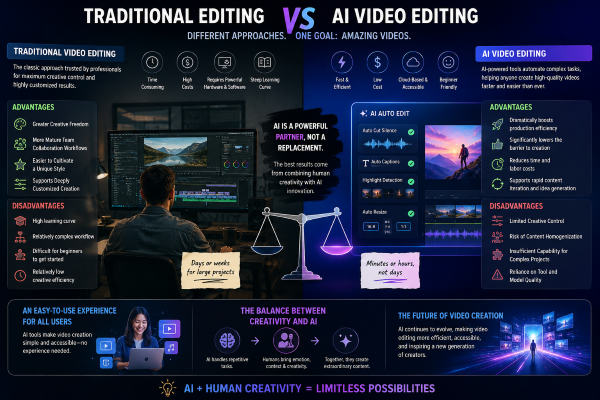
The speed at which online content is updated continues to increase at a rapid rate; therefore, “speed” is now primarily considered an important competitive differentiator in the creation of online content. Trends and hot topics change rapidly; therefore, the organization or person that can produce a high-quality video faster will have an opportunity to capture more traffic and interest.
The video creation landscape is being altered by AI. Creators are using AI tools to make things possible quickly and at lower cost than ever before. This rapid production process and improved production flow are making it easier for everyone to create high-quality videos. However, does AI-driven video creation replace conventional editing? There is still much that separates these 2 types of video creation.
Traditional Video Editing: The Time and Technical Costs Behind High Quality
For years now, video editing has been the primary way in which professionals create content. Video editing relies on different types of specific software that are used to edit footage/elements together through the use of visual effects/transitions/elements created by the user themself, while offering you increased flexibility and detail when it comes to the creation of videos.
That said, this editing method can be time consuming and requires a lot of effort. While creating short length videos may take several hours to complete, larger projects may take days or even weeks and will typically require professional editing software, creating a steep learning curve and requiring expensive hardware and therefore making it difficult for new creators to create content with the same amount of efficiency as experienced creators.
Advantages of Traditional Editing:
- Greater Creative Freedom
- More Mature Team Collaboration Workflows
- Easier to Cultivate a Unique Style
- Supports Deeply Customized Creation
Disadvantages of Traditional Editing Methods:
- High learning curve
- Relatively complex workflow
- Difficult for beginners to get started
- Relatively low creative efficiency
The emergence of AI and its applications for video editing are fundamentally changing how we create content today vs. how we traditionally created content. Traditional editing had so many labor intensive processes involved (e.g., going through hours of footage, removing pauses in the footage to create seamless edits, auto-generating subtitles and, auto-generating highlight reels from voluminous amounts of video footage) — while AI can automise dozens of those processes thereby reducing the time it takes to generate the end result versus traditional editing.
For example, you could now edit, condense, filter and generate multiple edited versions of content in an extremely short amount of time compared to traditional video editing.
With the increase in efficiency and speed of AI in the creation and editing of video content, this will be an incredible advantage for content creators in order to positively take advantage of trends. Feel free to share.
Beyond the advantage of speed, AI video tools also feature a lower barrier to entry. Many platforms offer templated workflows that allow users—even those with no prior editing experience—to quickly produce high-quality videos. Some AI tools can even automatically generate certain assets, making the entire creative process even simpler.
At the same time, AI video editing has also reduced the costs associated with content production. Compared to traditional professional software, high-performance hardware, and expensive human labor, AI tools are typically more affordable and accessible. This empowers individual creators, small teams, and small-to-medium-sized enterprises (SMEs) to produce videos—tasks that previously required a professional team—at a much lower cost.
Advantages of AI Video Generators:
- Dramatically boosts production efficiency
- Significantly lowers the barrier to creation
- Reduces time and labor costs
- Supports rapid content iteration and idea generation
Disadvantages of AI Video Generators:
- Limited Creative Control
- Risk of Content Homogenization
- Insufficient Capability for Complex Projects
- Reliance on Tool and Model Quality
An Easy-to-Use Experience for All Users
AI has revolutionized the video editing industry by allowing almost anybody to create high-quality videos. The barriers to entry for traditional editing are quite high, as they require a significant amount of investment in both software and hardware, along with strong technical knowledge to utilize them effectively. Historically, this has excluded many creative individuals from being able to produce video as a result of needing to be able to afford the equipment needed to create professional-looking videos.
There are currently many ways to edit video without having any experience. As stated by some technology reporters, using AI to create ai video has greatly reduced the obstacles that creators face when producing their content. This is accomplished through tools that simplify and speed up the workflow of creating content for the creator. By using these tools to make video production easier for the creators, those who have previously been excluded from video production due to costs or technical difficulties will have a much easier time beginning to create content and expressing themselves creatively through video.
The Balance Between Creativity and AI
There remain many unanswered questions about whether or not AI is truly creative, despite the number of exciting and rapidly developing tools showing just how far we can push the capabilities of machine learning. One question worth considering is whether AI can replicate the unique, subjective aesthetic sensibility and artistry that editors apply to their work. Many technical writers have recently reiterated that our view of this issue should be a bit more realistic; AI will function as an incredibly useful assistant instead of a complete replacement for the editorial process. Therefore, there is still an overwhelming need for editing to have human input and oversight when creating high-quality videos.
Let’s be clear before we proceed: AI has been developed as a tool for facilitating creativity in video editors, primarily through automation of many tedious aspects of video editing to increase efficiency and ease of use, rather than replacing the video editor.
Finally, AI does not have emotion or contextual comprehension like a human being. All AI’s judgment comes from either data-based algorithms and pattern-recognition or emotional indifference to subjective viewpoints.
Conclusion
Because of its many benefits—including speed and simplicity of use—the use of AI in video-editing is changing how content is created. People with little to no technical background, or no professional team, can now produce and release a larger amount of video content in significantly less time.
However, traditional editing skills will still play a pivotal role in content quality. Many creators are now experimenting with the blending of AI with traditional editing methods, trying to create more efficient processes while still having total creative control over their projects. AI editing is not just an “either/or” format; rather, it can work together with the expertise of humans, helping to optimize the entire workflow.
As the capabilities of AI continue to develop, video editing will be even more efficient and accessible in the future, resulting in a new generation of creators. This will give the audience access to an even greater and more varied range of creative expression through AI video tools, both for producers and viewers alike.