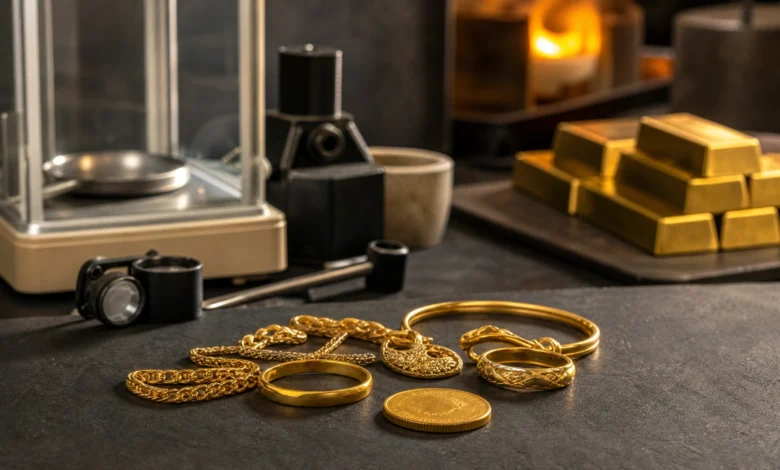
Most people understand that unwanted gold jewellery can be exchanged for money, but fewer know what happens to those items afterwards. An old wedding ring, broken necklace or collection of damaged bracelets may eventually become something completely different.
Gold dealers play an important role in this process by purchasing precious metals and returning them to the market through resale or refining.
The Journey Begins With an Assessment
When someone brings gold jewellery to a dealer, the first step is usually determining what the item contains.
Jewellery is manufactured using different gold alloys, so its appearance alone cannot reliably establish its purity. Testing may be required to determine how much actual gold is present.
Once the purity and weight have been established, the dealer can calculate an offer based on the prevailing gold price and the costs associated with processing the material.
What Happens to Broken Jewellery?
Many items purchased by gold dealers are no longer suitable for everyday use.
Broken chains, bent rings, damaged earrings and worn bracelets may have little appeal as second-hand jewellery. However, the gold contained within them remains valuable.
Rather than repairing these pieces, dealers may accumulate similar materials before sending them to a precious metal refinery.
This allows the gold to be recovered and reused instead of remaining indefinitely in jewellery boxes and drawers.
How Gold Refining Works
Gold refining involves separating gold from other metals and impurities to produce material of a higher purity.
For example, 9-carat jewellery contains 37.5% gold, with the remainder consisting of other metals. Refining processes can recover the gold from this mixture so that it can be used again.
Specialist refineries use sophisticated equipment and chemical processes to separate and purify precious metals.
The Royal Mint’s information about precious metal recovery and recycling provides an interesting introduction to the wider industry and the importance of recovering valuable metals.
Can Recycled Gold Become New Bullion?
Yes. Once gold has been refined to the required purity, it can be used to manufacture new products.
Recovered gold may eventually become investment bars, coins, jewellery or components used in industrial applications.
One of gold’s remarkable characteristics is that it can be melted and refined repeatedly without losing its fundamental properties.
This means gold originally used in a piece of jewellery decades ago could eventually be incorporated into an entirely different product.
What Happens to Gold Bullion?
Not everything purchased by gold dealers needs to be melted.
Recognised investment bars and coins may be suitable for resale in their existing form, particularly when they are genuine, identifiable and in acceptable condition.
Products that cannot readily be resold may instead be sent for refining, with the associated costs reflected in the buying price.
The Continuing Life of Gold
Unlike many everyday products, gold does not become useless simply because its original purpose has ended.
A damaged bracelet may be unsuitable for wearing, but its precious metal content can still be recovered and used again.
Gold dealers help facilitate this movement of precious metals between individuals, refineries, manufacturers and investors.
For someone selling unwanted jewellery, the transaction may represent the end of ownership. For the gold itself, however, it is often simply the beginning of another chapter.