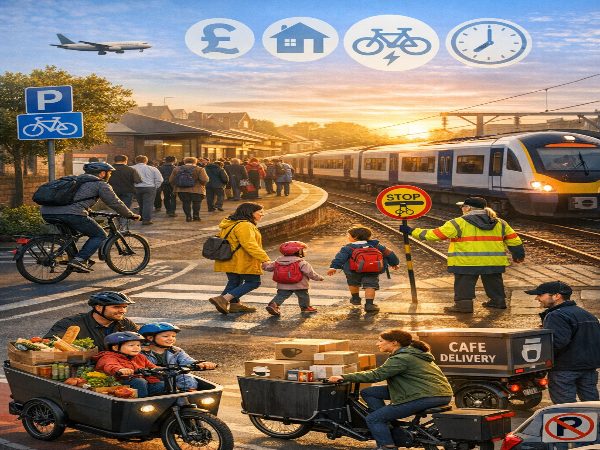
Early morning departures towards London continue to shape the rhythm of daily life for many residents in Berkhamsted and Tring. Station platforms fill before peak hours, while surrounding streets experience steady pressure from commuters searching for parking spaces before boarding southbound services. Housing costs across Hertfordshire have increased steadily, influencing household spending priorities and prompting some families to reconsider how they manage everyday transport.
For many households, local journeys accumulate quietly but significantly. School runs, supermarket visits, nursery drop-offs and short errands into town require time, fuel and planning. These routine movements can add financial pressure when combined with mortgage commitments and rail season tickets. As a result, more residents are reassessing how they travel within their own neighbourhoods and whether alternative options could offer greater efficiency.
Daily Travel in a Commuter Environment
Commuter towns often operate within tightly structured schedules. Rail timetables shape the start and end of the working day, while congestion increases around school hours and town-centre activity. Reviewing established routines can reveal practical ways to improve daily mobility without major disruption. Broader travel data, reflected in UK commuter travel patterns statistics, also shows how short urban journeys continue to influence transport choices across many regions.
Cycling has become an increasingly common choice for short journeys to Berkhamsted or Tring station. A brief ride can reduce parking stress and often save time compared with navigating peak-hour traffic. For distances under three miles, cycling provides a realistic option, particularly where quieter residential routes or designated cycle paths are available. Electric-assist bicycles further expand practicality by helping riders manage hills or transport heavier items linked to work or family commitments.
Preparation remains an important factor in sustaining consistent routines. Leaving slightly earlier can reduce pressure during busy periods, while testing alternative side streets often uncovers calmer routes. Local authorities across Hertfordshire continue to invest in cycling infrastructure, making it easier for residents to trial different travel patterns before committing to permanent changes.
When One Bike Needs to Meet Multiple Needs
Standard bicycles often serve commuters travelling alone, yet daily life becomes more complex when children, shopping or professional equipment are involved. Carrying capacity then becomes a defining consideration. Cargo bikes have become more visible in town centres for this reason, supporting both family routines and short-distance commercial tasks.
Discussion around two vs three wheeled cargo bikes frequently centres on balance, manoeuvrability and load stability. Two-wheeled designs generally feel more familiar to experienced cyclists and offer narrower frames suited to tighter urban infrastructure. Three-wheeled formats provide additional stability at lower speeds, particularly when transporting heavier loads or travelling with young passengers.
Street layout and typical journey patterns often shape how riders approach daily transport decisions in dense urban areas. Narrow access points near stations or busy high streets tend to favour slimmer cargo bike designs, while wider residential routes may accommodate larger load formats. Many urban commuters therefore review practical buying guidance published by Outspoken Cycles when assessing stability, load balance and manoeuvrability before choosing a cargo bike suited to everyday city travel. Urban mobility studies have also increased awareness of how different cargo bike configurations perform under routine commuting pressures.
Balancing Stability, Storage and Street Design
Local geography continues to influence transport practicality more strongly than promotional messaging or general trends. Berkhamsted High Street, characterised by steady pedestrian movement and periodic vehicle restrictions, rewards transport options that allow smooth navigation through constrained spaces. Residential side streets and cul-de-sacs introduce additional factors linked to turning circles and storage access.
Households considering cargo bike ownership must also evaluate how equipment fits into existing living arrangements. Garden sheds, side passageways and hallway dimensions all play a role in determining long-term convenience. In shared accommodation settings, clear arrangements regarding battery charging and secure storage can help maintain harmonious routines.
Weather exposure presents another consideration. Hertfordshire’s frequent rainfall and seasonal daylight variation require reliable lighting systems and robust locking mechanisms. Wider discussions around road safety environment measures across the UK highlight how infrastructure quality, visibility and predictable street layouts influence everyday travel confidence. Consistent preparation supports safe cycling throughout darker months, allowing residents to maintain confidence in alternative travel choices beyond summer conditions.
Changing Delivery Patterns Among Local Businesses
Transport reassessment extends beyond residential routines into the commercial landscape. Independent businesses across Berkhamsted and Tring continue to face rising operational costs related to vehicle maintenance, fuel consumption and urban parking limitations. Delivery logistics therefore remain a central component of financial sustainability, influenced by wider UK freight market conditions shaping how short-range distribution is organised in commuter towns.
Cargo bikes have emerged as a practical response for short-range distribution within town centres. Florists, cafés and mobile service providers benefit from improved mobility across pedestrianised zones or narrow residential streets. Reduced reliance on vans can help stabilise operating budgets while maintaining reliable customer service standards.
Visibility also plays a subtle role in local commerce. Branded cargo bikes travelling regularly through familiar routes contribute to community recognition without requiring formal advertising expenditure. However, business owners still need to consider insurance coverage, secure overnight storage and battery safety protocols to ensure consistent operational performance.
Long-Term Travel Adjustments in Growing Commuter Areas
Incremental changes in daily travel behaviour can gradually reshape both household budgets and overall quality of life in expanding commuter towns. Reviewing regular journeys, measuring realistic distances and identifying opportunities to replace short car trips with cycling or walking alternatives can support more efficient routines over time. Small adjustments to departure times or route choices often reduce congestion stress while improving consistency across school runs, station access and local errands.
Transport decisions in areas such as Berkhamsted and Tring also reflect wider pressures linked to housing affordability and commuter demand. As living costs continue to influence household priorities, residents increasingly look for travel options that balance financial stability with reliable day-to-day mobility. Flexible short-distance travel choices can help households maintain independence while adapting to evolving urban layouts and changing traffic patterns.
Over time, small adjustments to everyday journeys can ease financial pressure and improve the rhythm of daily life in commuter towns. By rethinking short local trips and aligning travel choices with real street conditions, households can build routines that feel more manageable and consistent. Practical mobility decisions made today can support steadier budgets, calmer schedules and a stronger sense of control over everyday movement.