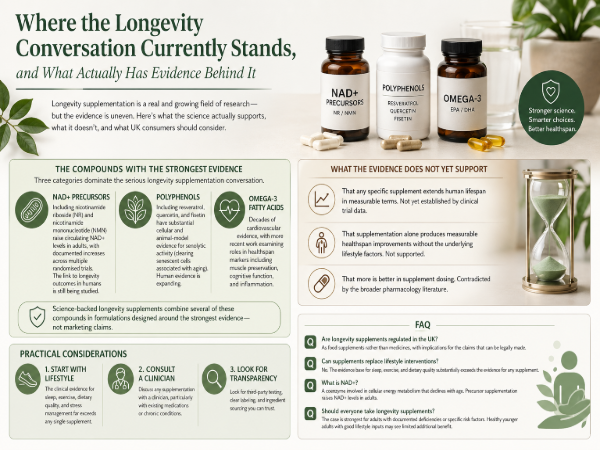
Where the Longevity Conversation Currently Stands, and What Actually Has Evidence Behind It

The longevity conversation has moved from a niche scientific subculture to a mainstream wellness category in less than a decade. UK consumers, like American ones, now encounter longevity content on every platform from prestige podcasts to high-street pharmacy shelves, and the supplement category that has grown alongside it is now substantial enough to warrant a careful look at what the evidence actually supports.
The honest summary, before any specific compound is discussed, is that longevity supplementation is genuinely a real research area, the science is real, and the supplement category is uneven. Some compounds have substantial published evidence. Others have plausible mechanisms with limited human data. A meaningful share of the marketing claims goes beyond what current research actually supports.
The compounds with the strongest evidence
Three categories of compound dominate the serious longevity supplementation conversation.
NAD+ precursors
including nicotinamide riboside and nicotinamide mononucleotide raise circulating NAD+ levels in adults, with documented increases across multiple randomised trials indexed on the U.S. National Library of Medicine’s PubMed platform. Whether the increased NAD+ levels translate into measurable longevity outcomes in humans is still an active research area, but the underlying biochemistry is well-established.
Polyphenols
including resveratrol, quercetin, and fisetin have substantial cellular and animal-model evidence for senolytic activity (clearing senescent cells associated with aging). The human evidence is less complete but expanding.
Omega-3 fatty acids
have decades of cardiovascular evidence, with more recent work examining their role in healthspan markers including muscle preservation, cognitive function, and inflammatory markers.
For UK consumers exploring this category, science-backed longevity supplements like those offered through Wisp’s longevity range typically combine several of these compounds in formulations designed around the strongest evidence rather than around marketing claims.
What the evidence does not yet support
Several claims commonly made in wellness contexts go beyond current research.
The idea that any specific supplement extends human lifespan in measurable terms is not yet established by clinical trial data.
The idea that supplementation alone produces measurable healthspan improvements without the underlying lifestyle factors (sleep, exercise, dietary quality, stress management) is not supported.
The idea that more is better in supplement dosing is contradicted by the broader pharmacology literature.
Practical considerations
For UK consumers weighing longevity supplementation, three habits cover most of the practical decision.
Start with the underlying lifestyle inputs. The clinical evidence for sleep, exercise, dietary quality, and stress management substantially exceeds the evidence for any individual supplement.
Discuss any supplementation with a clinician, particularly with existing medications or chronic conditions.
Look for product transparency including third-party testing documentation and ingredient sourcing.
FAQ
Are longevity supplements regulated in the UK?
As food supplements rather than medicines, with implications for the claims that can be legally made.
Can supplements replace lifestyle interventions?
No. The evidence base for sleep, exercise, and dietary quality substantially exceeds the evidence for any supplement.
What is NAD+?
A coenzyme involved in cellular energy metabolism that declines with age. Precursor supplementation raises NAD+ levels in adults.
Should everyone take longevity supplements?
The case is strongest for adults with documented deficiencies or specific risk factors. Healthy younger adults with good lifestyle inputs may see limited additional benefit.