Why Women’s Probiotic Supplementation Has Become a Recognised Wellness Category

For most of the probiotic industry’s recent history, the category was treated as gender-neutral. A probiotic was a probiotic. Strain selection focused primarily on gut health, the marketing addressed a general adult audience, and the specific microbiome environments that differ between women and men were largely ignored at the consumer-product level.
That has changed substantially. Women’s-specific probiotic formulations have grown into a substantial slice of the broader probiotic market, driven by a combination of microbiome science advances, consumer demand for products that address women’s specific health concerns, and the recognition that vaginal, urinary, and gut microbiomes interact in ways that gender-neutral formulations did not adequately address.
What women’s-specific probiotics actually do
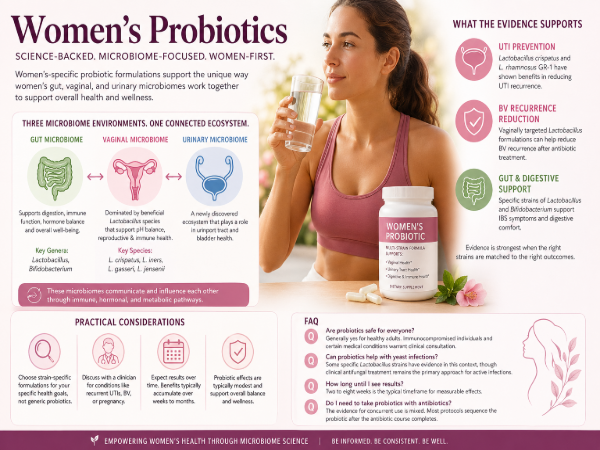
Three microbiome environments matter for women’s health, and they communicate with each other through documented pathways.
The gut microbiome influences systemic inflammation, hormonal metabolism, immune function, and the broader metabolic environment. The standard probiotic genera (Lactobacillus, Bifidobacterium) are well-studied for gut health benefits.
The vaginal microbiome has a distinct profile dominated by specific Lactobacillus species (L. crispatus, L. iners, L. gasseri, L. jensenii). The U.S. National Institutes of Health has funded substantial research on vaginal community state types and their implications for reproductive health, infection susceptibility, and pregnancy outcomes.
The urinary microbiome, only recently established as a real microbial environment rather than the previously assumed sterile space, has implications for urinary tract infection susceptibility and bladder health.
A modern womens probiotic formulation typically targets several of these environments through strain selection optimised for the female microbiome rather than for general gut health alone.
What the evidence supports
The strongest evidence base supports specific applications.
Recurrent UTI prevention. Lactobacillus crispatus and L. rhamnosus GR-1 have documented effects on UTI recurrence in published trials.
BV recurrence reduction. Vaginally targeted Lactobacillus formulations have evidence for reducing BV recurrence following antibiotic treatment.
Gut-related symptoms. Standard probiotic genera have evidence for IBS symptom management and broader digestive comfort.
The evidence is strongest when strain-specific formulations are matched to specific clinical applications rather than when generic formulations are used for unrelated outcomes.
Practical considerations
Choose strain-specific formulations rather than generic probiotic products when the goal is a specific health outcome.
Discuss probiotics with a clinician for any specific condition, particularly recurrent UTIs, BV, or pregnancy.
Be aware that probiotic effects are typically modest and accumulate over weeks to months rather than producing immediate symptom resolution.
FAQ
Are probiotics safe for everyone?
Generally yes for healthy adults. Immunocompromised individuals and certain medical conditions warrant clinical consultation.
Can probiotics help with vaginal yeast infections?
Some specific Lactobacillus strains have evidence in this context, though clinical antifungal treatment remains the primary approach for active infections.
How long until I see results?
Two to eight weeks is the typical timeframe for measurable effects.
Do I need to take probiotics with antibiotics?
The evidence for concurrent use is mixed. Most protocols sequence the probiotic after the antibiotic course completes.