How a Quiet Construction Innovation Is Helping the UK Industry Catch Up on Productivity

UK construction has spent the past decade in an uncomfortable conversation about productivity. Reports from government agencies, industry bodies and individual contractors have circled the same conclusion. Output per worker has been broadly flat for years, even as the rest of the economy has digitised. The reasons are tangled: skills shortages, planning delays, fragmented supply chains, the legacy of project-by-project procurement. None of these problems has been solved by a single innovation, and probably none of them will be.
But quietly, in the corners of the industry where productivity actually gets measured day by day, there has been a string of unglamorous product-level changes that, in aggregate, are making a difference. One of them is sitting on the floor of almost every commercial project in the country.
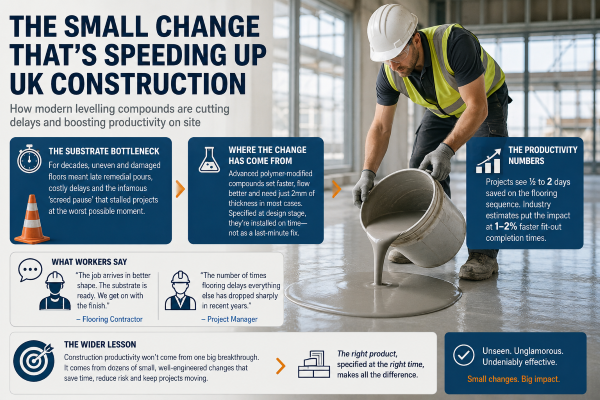
The Substrate Bottleneck
For most of the past thirty years, the floor finish on a UK commercial fit-out has been one of the slowest parts of the build sequence. The flooring contractor is sequenced near the end of the programme, because almost everything else has to be in place before the finish can go down. By the time the flooring team arrives on site, the substrate has been walked on, scraped, dropped on, and exposed to whatever weather the project let in. It is rarely flat to the tolerance the finish requires.
The traditional response was a remedial pour, often by a separate sub-contractor brought in at short notice, often on a premium rate, and often holding up everything that was meant to follow. The trade nickname for the resulting delay, “the screed pause”, captures how predictable it had become.
Where the Change Has Come From
The newer generation of self-levelling compounds being specified into UK commercial projects has reshaped that part of the programme. The chemistry has moved on substantially over the past decade. Modern polymer-modified products mix at lower water ratios, set within a few hours, and accept foot traffic the same day. Applied thickness can be brought down to a couple of millimetres in most cases, which keeps the floor levels coordinated with adjoining trades.
More significantly, the product is now specified at design stage rather than introduced as a remedial step. The contractor knows from the drawings that the substrate will receive a levelling layer. The programme allocates the day. The flooring sub-contractor sequences after that pour rather than ahead of it.
The Productivity Numbers
The headline shifts have been measurable. Industry surveyors working on larger commercial projects report half-day to two-day reductions in the flooring sequence simply because the substrate is uniformly prepared rather than being discovered as variable on site. A delay that used to cost three trades a day each has, in many cases, disappeared.
The cumulative impact across a year’s worth of projects in a single contractor’s portfolio is not trivial. Industry estimates suggest that the spec change alone is worth one to two per cent on commercial fit-out completion times, which is, by the standards of UK construction productivity research, a substantial number.
What Construction Workers Say
The view from the trade itself is consistent with the survey data. Flooring contractors describe the change in matter-of-fact terms. The job arrives in better shape. The substrate is ready to receive the finish. The remedial work has been moved off the critical path and into the design stage where it belongs.
Project managers describe it differently. The number of times the flooring sequence delays everything else has, in their experience, dropped sharply over the past few years. That is the kind of change that does not make industry headlines but quietly turns up in the project closeout reports.
The Wider Lesson
There is a temptation, in the discussion of construction productivity, to look for a single transformational innovation. The truth is that the industry will catch up the way most industries do: through dozens of unglamorous product-level changes, each saving an hour or a day here and there, that compound across the year into a measurable improvement.
The levelling compound under the floor is one of those changes. It is not the most photogenic one, and it does not feature on the press release at handover. But it is the kind of small, well-engineered, well-specified detail that, multiplied across every project in the country, is quietly helping the industry turn a corner.