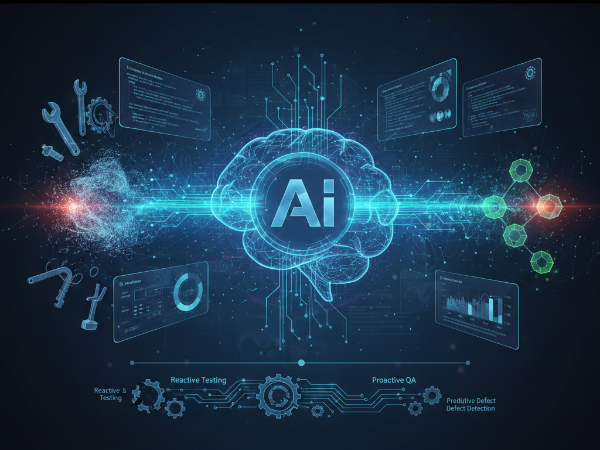
AI is not a new concept in software testing anymore – it is becoming the silent force behind increased releases and smarter decision-making. With increasingly complex products and shorter release times, conventional automation begins to experience a sense of an inflexible set of tools attempting to keep up with a moving object. You may well have experienced it yourself: scripts that fail when you make minor changes to the UI, regression tests that take days to complete, and edge cases that fall through because no one had time to draw them on a whiteboard. It is where AI alters the rhythm.
The significance of this shift lies in the fact that AI is turning test automation into a reactive process and making it nearly perceptive. Rather than letting failures manifest themselves, machine learning models identify patterns in defect history, user behavior, and even highlight weak spots in the codebase before they can cause trouble. Instead of merely verifying that features are working, you suddenly know why they are failing, the probability of them failing again, and what you need to work on next. It is a radical change of scripts to smartness.
This is important since each software team is under pressure to work quickly without losing customer confidence. And as your systems grow to environments, devices, and integrations, the old patterns of automation construction just do not go that far. The AI-driven approaches are offering something more sustainable: adaptable test suites, which prioritize themselves and offer insights that you can really take action on.
Next, we will examine the ways AI is transforming the practices of test automation and what it implies to any team that is attempting to develop reliable software at modern speed.
AI-Powered Enhancements to Traditional Test Automation
Smarter Test Case Generation and Maintenance
AI introduces a higher degree of intelligence in creating tests through analysis of application behavior, user flows, and past defects. You do not have to write out all the scenarios manually, but you can count on systems that learn about the usage of your product and suggest the appropriate test cases. This minimizes blind spots and assists in keeping the coverage as your application changes.
Maintenance is where this is of particular value. Conventional regression suites tend to swell with time, like with redundant or obsolete scripts. AI can be used to reduce that noise by marking outdated tests, detecting duplicates, and revising scripts in response to changes in UI or workflow. It offers a more adaptive approach than static automation – one that aligns well with autonomous software testing models.
Predictive Defect Detection and Prioritization
Machine learning introduces an extra level of efficiency as it identifies the areas of high risk before problems occur during production. These models look at commit history, system logs, past failures, and even code complexity to tell where the defects are likely to occur.
It is with that understanding that you are able to better prioritize testing efforts. Teams are not dispersing their attention equally throughout the codebase, but on the modules that have the highest potential to break. This saves on time wastage, enhances confidence in release, and promotes quicker decision-making.
Advanced AI Approaches for Continuous and Scalable QA
Continuous Testing Powered by Real-Time AI Insights
Since teams are pushing updates at high velocity through CI/CD pipelines, AI is needed to maintain validation as continuous and reliable. Anomaly detection based on AI tracks all the builds and identifies any performance, response time, and functionality anomalies. You do not have to wait until a complete regression cycle completes – instead, you are alerted when something is acting in an unexpected manner.
This reduces your feedback loop by a long margin. The defects are detected sooner, the ship is fixed more quickly, and the quality is more predictable. With ai driven test automation, these checks evolve automatically as your system grows, reducing the bottlenecks that slow down traditional QA cycles.
Optimizing Coverage and Resource Allocation at Scale
AI is also able to examine your current test libraries and determine which scenarios actually help to reduce risk. It identifies unnecessary cases, exposes gaps in the critical paths, and determines the minimum number of tests to be carried out to guarantee confidence in every release.
This assists you in focusing your efforts where they are most needed. Rather than flooding pipelines with thousands of redundant tests, AI suggests specific suites that are speedy and accurate. The outcome is a scaling QA process that works in multi-platform environments without increasing infrastructure costs or introducing noise to the release cycle.
Conclusion
The more you consider the impact of AI on test automation, the clearer it becomes that QA is shifting from a reactive to a proactive and even predictive role. Teams can now predict weak spots, create smarter test coverage, and have systems that can keep up with the product development instead of waiting until failures manifest themselves.
And reflecting on all that has been discussed here, it is not only efficiency that is the true benefit. It is the capacity to drive development with much greater confidence. By integrating AI-enhanced testing strategies into your work process, you will have an advantage over competitors: you will make decisions faster, you will not have many surprises before the release, and you will have a testing engine that will become stronger with each cycle.
It is a reminder that the adoption of AI in the automation process is not only a technical upgrade. It is a tactical step that will place your organization in a better position to create better software and create it in a clear, fast, and sustainable manner.