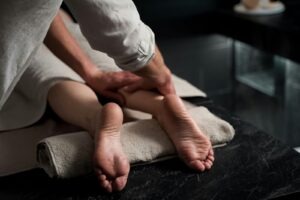
You can’t put a price on good health, and that’s true of every part of your body. Foot health isn’t a topic that typically comes up, at least until discomfort or immobility become issues to daily life. Your feet are, however, integral to your quality of life, being that they bear the entire weight of the body and facilitate movement across varying terrains. As such, their health and structural integrity are paramount. When podiatric issues arise, they very often trigger a chain reaction, which can have consequences for the ankles, knees, hips, and even the lower back.
Fortunately, the combined approach of physiotherapy and custom orthotics offers a robust solution for restoring function and alleviating pain. By addressing both the biomechanics of movement and the structural support of the foot, these interventions can have profound benefits for your quality of life.
Here are the key ways these therapies work together to optimize foot health:
1. Correcting Biomechanical Misalignment
Proper alignment is the ultimate basis for foot health. Biomechanical issues (such as overpronation (rolling inward) or supination (rolling outward) are very often the cause of pain and injury, particularly to soft tissues and joints related to the feet. Physiotherapists are specifically trained to assess such irregularities in the course of a physical examination. For residents seeking physiotherapy in Markham, the focus is very often on manual therapy techniques designed to mobilize stiff joints and release tight muscles. By restoring the natural range of motion in the foot and ankle, physiotherapy restores the body’s ability to move more efficiently, which serves to reduce the risk of repetitive strain injuries.
2. Enhancing Stability Through Gait Analysis
A diagnosis is always a must for understanding a patient’s difficulties; in the case of foot problems, the issue is diagnosing how a person walks. A comprehensive assessment often involves observing the gait cycle to identify where inefficiencies occur. A specialized foot clinic in North York will typically look at how the foot strikes the ground, absorbs shock, and pushes off. Analyzing the gait in this way can be most revelatory concerning whether the foot requires additional stability or cushioning. If the foot is unstable during the stance phase of walking, that instability can lead to issues like plantar fasciitis or Achilles tendinitis. It takes a targeted approach to address these patterns, one that very often begins with an in-depth understanding of the specific movement faults unique to the individual.
3. Providing Precision Support with Custom Orthotics
While generic shoe inserts offer some degree of cushioning, they are built to a general standard and so lack the structural correction provided by custom orthotics. Custom devices are prescribed medical appliances designed to control the specific abnormal foot function of a given patient. When looking for orthotics in Kitchener, patients generally undergo a casting or scanning process to create a mould of their feet. This ensures the resulting orthotics are engineered to hold the foot in a neutral position, and in doing so reduce tissue stress. Unlike mass-produced insoles, custom orthotics are designed for a particular patient’s feet. To that end, they are fitted to the millimetre to address specific discrepancies (such as leg length differences or collapsed arches).
4. Strengthening and Rehabilitation
While orthotics are there to provide external support, physiotherapy’s purpose is to build internal strength. A rigid foot needs mobilization, for example, whereas a hypermobile foot needs stabilization. Physiotherapy programmes prescribe specific exercises to strengthen the intrinsic muscles of the foot and the extrinsic muscles of the lower leg. For example, picking up marbles with toes or performing towel scrunches are intended for building arch strength. This active component ensures that the foot does not become solely reliant on the orthotic device but also develops the capacity to support itself over time.
5. Long-Term Injury Prevention
The ultimate goal of combining these various modalities is the prevention of future injuries. The combination of aligning the skeletal structure with orthotics and conditioning the soft tissues with physiotherapy is specifically intended to enable patients to walk without pain. These measures taken together ensure that minor aches don’t escalate to chronic conditions. Taking this approach also transforms foot care from a reactive treatment of symptoms to a proactive and sustainable management of overall physical health.
There’s no denying physiotherapy can help patients with podiatric issues, as can custom orthotics. However, combining both treatments creates a more comprehensive strategy for lasting foot health. By taking these insights into account, you can use a dual approach to address root causes rather than just symptoms. Prioritizing these interventions gives you the opportunity to move through life with comfort, confidence, and improved mobility.