Most people leave the house without thinking much about it. Keys, phone, door. For someone with a mobility impairment, that same departure involves checking whether the accessible taxi is available, whether the ramp at the station is working, and whether the whole thing might fall apart anyway ten minutes before leaving.
The Motability scheme exists to change that calculation. Not completely. But enough that the answer to “can I get there?” becomes more reliably yes.
The Hidden Time Cost of Limited Mobility
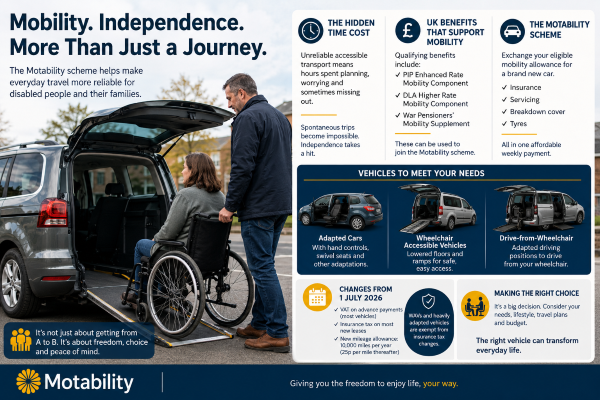
Accessible transport in the UK is inconsistent. In some rural areas, accessible vehicles may be limited and spread across a wide area. Book ahead or go without. Urban settings run a different problem entirely. In busy urban areas, demand for accessible taxis can outstrip supply. Same-day service is rarely guaranteed. A previous booking running late cancels a medical appointment that took weeks to arrange. Nobody compensates for that.
Spontaneous travel becomes nearly impossible. Every outing requires advance logistics. Invitations get declined not because someone does not want to go, but because the transport cannot be confirmed in time. Families managing this regularly describe the psychological weight as significant and separate from the physical barriers themselves.
For people who qualify for higher-rate mobility allowances, the motability car scheme can reduce that dependency on public or community transport by putting a dedicated vehicle under the family’s control.
How UK Disability Benefits Support Mobility
Two main benefits fund mobility support for disabled people in the UK. Personal Independence Payment usually applies from age 16 to State Pension age. Disability Living Allowance applies to those who claimed before PIP was introduced. Both include a mobility component that can be directed toward transport costs rather than received as cash.
The Enhanced Rate of the Mobility Component of PIP and the Higher Rate Mobility Component of DLA both qualify for the scheme. War Pensioners’ Mobility Supplement also qualifies. Benefit rates are set by government and reviewed periodically. Checking current figures directly through GOV.UK before making any decisions gives the most accurate picture.
Wheelchair use is not a requirement for qualifying. Many people with conditions affecting stamina, pain, or cognitive function qualify without using a wheelchair at all. The assessment looks at how a condition affects the ability to move around and plan journeys. The equipment someone uses is not the deciding factor.
Qualifying and Applying
PIP applications can take several months, though exact timescales vary. Claimants need at least 12 months remaining on their award to join the scheme. Eligibility depends on receiving one of the qualifying benefits at the higher or enhanced rate.
The disability car scheme structure removes the financial barrier that excludes many disabled people from standard vehicle finance. The lease usually includes insurance, servicing, breakdown cover, and tyre replacement within a single weekly payment. No separate insurance policy to arrange, no unexpected servicing bill arriving in a difficult month. The weekly cost covers the vehicle and the running of it together.
Some vehicles carry no advance payment. Others require an upfront contribution depending on the model chosen. For those who do not qualify, private adaptations and other support routes may still be worth checking. The scheme is the most comprehensive option for those who do qualify.
What the Right Accessible Vehicle Needs to Cover
The vehicle range covers more than most families expect before they start looking. Standard adapted cars with hand controls or swivel seats. Wheelchair accessible vehicles with lowered floors and hydraulic ramps. Drive-from-wheelchair models for users who drive from their own chair. Each category serves a different set of daily needs.
WAV configurations come in three forms. Rear-entry models deploy a ramp from the back of the vehicle, which needs clear space behind to work. Side-entry models load from the kerb, which suits school drop-offs, supermarket car parks, and anywhere urban parking puts the vehicle alongside a pavement rather than nose-in to a space. Drive-from-wheelchair models adapt the entire driving position for the user’s chair.
Adaptations on scheme vehicles are built into the lease cost rather than priced separately. That removes the risk of underestimating modification costs when comparing options at the point of choosing a vehicle.
Regulatory Changes Taking Effect from July 2026
From 1 July 2026, new tax rules change the cost structure for most new leases. VAT applies to advance payments on standard vehicles. Insurance Premium Tax applies to most new lease agreements. These updates replace reliefs that have been in place for over forty years.
WAVs and heavily adapted vehicles are exempt from the insurance tax change. The Motability Foundation has confirmed that wheelchair accessible vehicles retain their insurance-relief exemptions under the new rules. That distinction matters when families are choosing between a standard adapted car and a full WAV. The costs diverge under the new structure in ways they did not previously.
The standard annual mileage allowance moves to 10,000 miles for new orders placed on or after 1 July 2026, with excess miles charged at 25p per mile. Orders placed before that date keep the previous mileage terms. Anyone considering a new order should check whether the July 2026 timing affects their decision, because ordering before or after that point produces different financial terms across the length of the lease.
Making the Decision
Giving up the mobility allowance is not a small choice. Some families still need that cash for taxis, fuel, hospital trips, or other mobility costs that do not disappear just because a vehicle is available. That trade-off needs looking at properly before anyone applies.
Where a dedicated vehicle solves the bigger problem, weekly costs become easier to see. Insurance, servicing, tyres, and breakdown cover are not scattered across separate bills. They sit inside one commitment. Cleaner, yes, but still something a family has to weigh properly.
The 2026 changes add another thing to check before signing. Mileage rules. Eligibility. The layout of the vehicle. Where the ramp opens, who drives, how often the family travels, and whether the weekly cost still leaves room for the other bits of life. A choice can look fine on paper and still be wrong outside a hospital entrance on a wet morning. That is where the decision really shows itself.