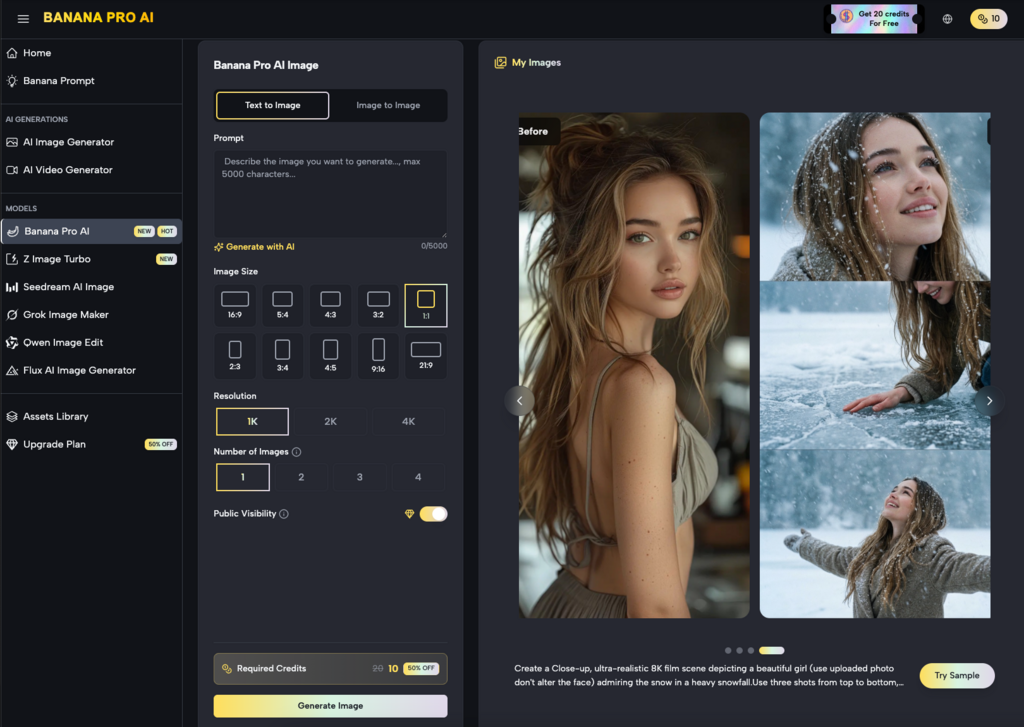
Most people approach AI video tools expecting motion to be the breakthrough. In reality, the first bottleneck is often less dramatic: finding a visual idea that can survive more than one frame. That is why Banana Pro AI is worth looking at through a slightly different lens. Based on the provided information, it is a free online image generator that supports both text-to-image and image-to-image conversion.
For beginners, that makes it useful not as a complete video solution, but as a low-pressure place to test visual directions before they become clips, reels, or ad concepts. If you found this topic while searching for an AI Image Editor or a broad term like Nano Banana, the practical question is not whether one tool can replace the whole creative process. It is whether it helps you reach a workable starting frame faster.
The common assumption is simple: if the goal is video, start with video.
That sounds logical, but it often creates frustration early.
A lot of first-time users are not really struggling with motion. They are struggling with decisions that existed before motion: what the subject should look like, what mood the scene needs, whether the image feels clean enough to build on, and whether the idea is specific enough to repeat across multiple frames.
That is where a tool like Banana Pro AI becomes relevant to an AI video workflow without needing to be described as a video tool.
People often use the term AI Image Editor loosely. Sometimes they mean editing in the strict sense. Other times they mean any tool that helps them generate, reshape, or iterate on visuals. In practice, that search behavior tells you something important: most beginners are not asking for perfection. They are asking for help getting unstuck.
I have seen creators lose more time trying to animate a weak concept than they would have spent making one stronger still image first. That is usually the first expectation reset. The “magic” is not in skipping thinking. It is in shortening the distance between a vague idea and a visual draft.
Whether someone arrives through a search for Nano Banana or a more direct query, the pattern is similar. They want speed. What they learn quickly is that speed matters most at the concept stage, not just the output stage.
Week one usually looks messy, and that is normal
The first week with a tool like this rarely looks polished.
It looks exploratory.
That is a good sign.
Banana Pro AI supports two modes that map well to how beginners actually think: starting from text when the idea is still vague, and starting from an image when the direction is already partially visible. Those are not just technical options. They reflect two different creative states.
When text is enough
Text-to-image tends to help most at the beginning, when the user is still trying to answer basic questions.
Not “How do I make the final asset?”
More like:
What style fits this campaign or post?
Should the scene feel product-focused or atmospheric?
Is the concept playful, clean, dramatic, or neutral?
Does the subject need to be realistic, stylized, or somewhere in between?
Beginners often assume the first prompt should be precise and masterful.
Usually it should just be useful.
That means generating rough directions, spotting patterns, and noticing what feels closer to the original intent. In this stage, an AI Image Editor mindset helps more than a “final production” mindset. You are editing your own thinking before you are editing content.
Searches around Nano Banana often come from this exact impulse: find something lightweight enough to experiment with before committing a lot of time. That instinct is sound. What changes after a few sessions is the goal. People stop chasing the single perfect prompt and start treating the tool as a fast sketch space.
When image-to-image becomes more helpful
Image-to-image usually becomes more useful once the user has something to steer from.
That could be:
an older creative asset
a rough concept image
a reference frame
a product shot that needs a different mood or setting
This is where beginners often feel a second shift. The workflow becomes less about surprise and more about control.
A lot of people start with AI tools hoping to be impressed. A few days later, they mainly want consistency.
That is a healthy progression. If the end goal is short-form video, social content, or a sequence of related visuals, consistency matters more than novelty. A visually striking image that cannot be repeated is interesting, but not always useful.
Banana Pro AI, viewed this way, fits the early and middle stages of content development. It helps turn “I have an idea” into “I have a direction.” That is a smaller promise than most beginners hope for, but it is often the more valuable one.
The middle of the process is mostly about judgment, not generation
By the second or third week, the tool itself usually stops being the main story.
Judgment becomes the story.
This is where many people discover that AI-assisted creation does not remove taste, selection, or manual decision-making. It makes those skills more visible.
The outputs that help most are not always the most dramatic. In my own testing across visual tools, the images that save time are usually the ones that leave fewer problems for the next step. They are easier to crop, easier to adapt, easier to pair with text, and easier to imagine as part of a sequence.
For anyone trying to feed still visuals into an AI video workflow, four questions start to matter:
Can this image be repeated or varied without drifting too far?
Does the subject read clearly at small sizes?
Is the composition stable enough for captions, overlays, or motion effects?
Would I build a second frame from this, or am I already trying to fix it?
That last question is underrated.
A lot of beginners keep weak outputs because they feel “almost there.” That can create a hidden time cost. A frame that looks close enough may still require too much cleanup, too much reinterpretation, or too much compromise once it enters a real content pipeline.
This is where the broader AI Image Editor category can be misunderstood. People sometimes expect the tool to solve creative ambiguity for them. It does not. What it can do is expose ambiguity faster. If the concept is unclear, the output often shows that immediately.
That is useful.
A Nano Banana style search often begins with curiosity, but by this point the real value is less playful than people expected. It becomes operational. You start noticing whether the tool helps you make decisions faster, reject weak directions earlier, and preserve momentum when the blank page would otherwise slow you down.
By the end of the month, the real question is whether it stays in the workflow
After a few weeks, the evaluation becomes more honest.
Not “Did it make something impressive?”
But “Did it make my process better?”
For solo creators and small teams, that question matters more than the novelty factor.
A tool like Banana Pro AI earns its place when it reduces the cost of early exploration. That could mean helping someone test multiple visual routes before choosing one. It could mean giving structure to a loose concept. It could mean turning one usable image into a family of related directions through image-to-image experimentation.
It does not need to replace design judgment to be worthwhile.
In fact, beginners usually get more durable value when they stop asking for replacement and start asking for leverage.
A simple self-check at the end of the first month looks something like this:
Am I getting to a first visual draft faster than before?
Do I understand when to start from text and when to start from an image?
Have I become better at spotting usable outputs, not just attractive ones?
Does this fit the kind of content I actually publish?
If the answer is mostly yes, the workflow has a future.
If the answer is no, the issue is not always the tool. Sometimes the mismatch is between the user’s expectation and the real job that needs to be done. Someone looking for a one-click content machine may be disappointed. Someone looking for a faster way to explore, compare, and refine ideas may find more lasting value.
That is the quieter truth behind many AI Image Editor searches and plenty of Nano Banana curiosity too. People think they are shopping for automation. Often they are really searching for a better first draft.
With Banana Pro AI, the realistic starting point is not polished video output. It is visual groundwork. And for many beginners, that turns out to be the part that matters most.